
From Galileo’s Floating Mystery to Modern Precision: The Fascinating Evolution of Thermometers
Galileo Galilei (1592) is generally credited as the inventor of the thermometer. He created a device called the "thermoscope." The thermoscope consisted of a glass cylinder
filled with a transparent liquid and weighted objects of varying densities. When temperature changed, the liquid's density would shift, causing the suspended weights to rise
or fall until they matched the density of the surrounding liquid. The least dense weight would settle at the top, while the densest would sink to the bottom. Each weight carried
a metal tag engraved with a number. To read the temperature, one would observe the lowest suspended weight near the top of the column.
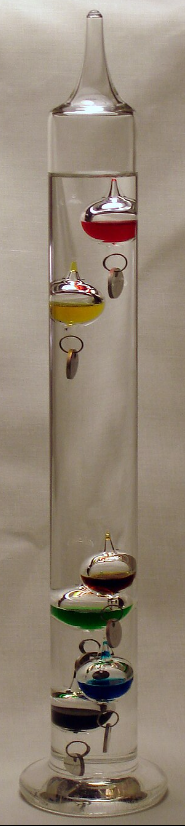
The working principle of the Galileo thermometer is buoyancy.
Buoyancy generally refers to the upward force exerted by a fluid (liquid or gas) on an object, which is why a steel ship can float (while a solid steel bar would sink). Whether an object floats in a liquid depends on two factors:
The object's own weight
The weight of the displaced fluid
If the object's weight is less than the displaced fluid's weight, it floats.
If the object's weight is greater than the displaced fluid's weight, it sinks.
If the weights are equal, the object remains suspended in the fluid.
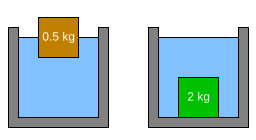
In the example above, the floating object is in water with a density of 1 kg/L, meaning each submerged object displaces exactly 1 kilogram of water. Galileo discovered
that a liquid's density slightly changes with temperature: when temperature rises, the liquid's density decreases. This phenomenon is the key operating principle behind
the Galileo thermometer.
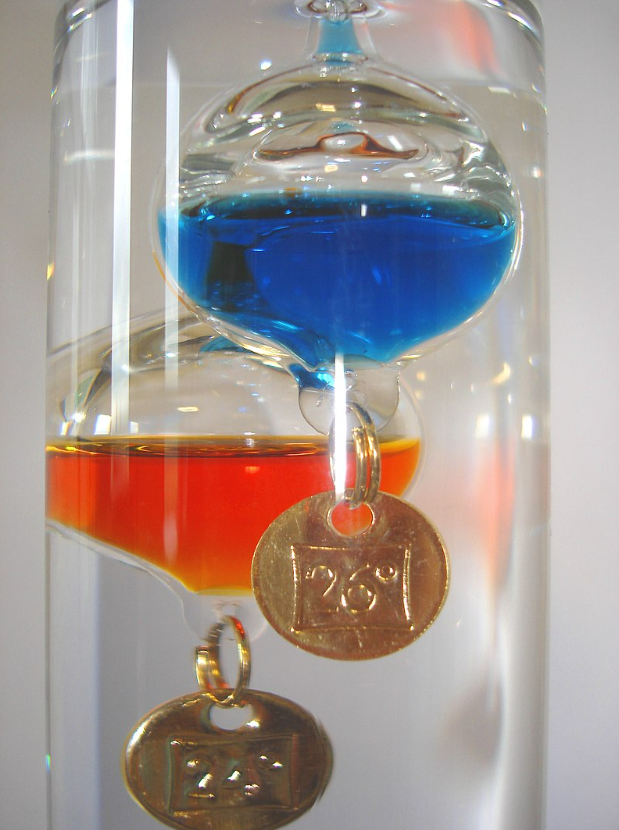
In the Galileo thermometer, each small glass bulb contains a differently colored liquid. The liquid's composition does not affect the thermometer's operation—the colors
are purely decorative. After being sealed through glassblowing, the effective density of each glass bulb is precisely adjusted by the attached metal tag. Since the volume
of the glass bulbs is fixed, temperature-induced expansion of the internal gas or liquid has negligible impact.
The surrounding transparent fluid is not water but an organic solution (e.g., ethanol), chosen because its density changes more significantly with temperature compared to water. This is critical because:
Water anomaly: Water reaches maximum density at 4°C. Below this temperature, it expands (density decreases) until freezing (0°C).
Cause: Hydrogen bonding forms an open hexagonal crystal structure (ice), increasing volume.
Alcohol behavior: Lacking strong hydrogen-bond networks, alcohol molecules pack more tightly as temperature drops, causing continuous shrinkage.
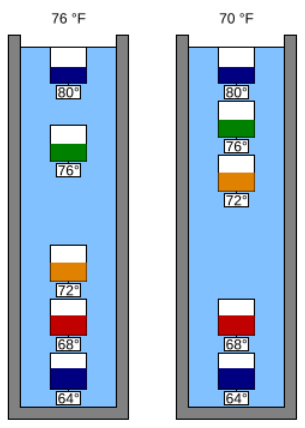
The image above illustrates a Galileo thermometer at different temperatures (units in Fahrenheit).
When some bulbs float at the top, some sink to the bottom, and one remains suspended in the middle (left image):
The suspended bulb (e.g., the green one at 76°F) indicates the ambient temperature.
If no bulb is suspended in the middle (right image):
You may either:
Take the average of the highest sunk bulb (bottom) and the lowest floating bulb (top), or
Directly read the tag of the lowest floating bulb (topmost sunken bulb’s adjacent tag).
Many people wonder—what's the heart of a portable ice maker?
Related Article


existed—aristocrats indulged in "bing luo," a luxurious icy treat that would put modern gelato to shame. Let’s uncover this delicious history...